Identify cafeteria patrons count
using AI
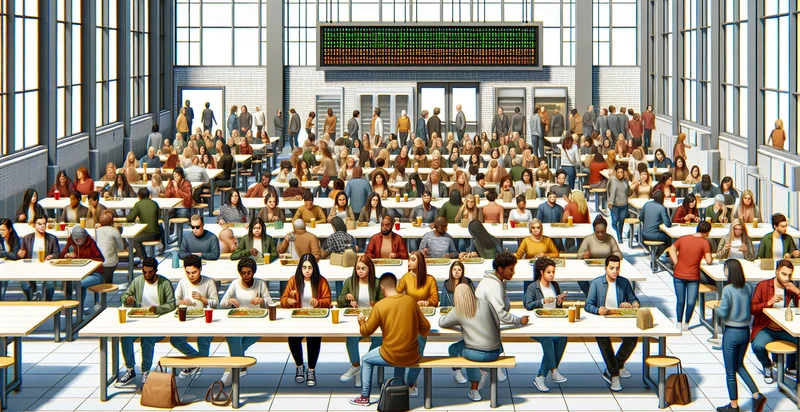
Below is a free classifier to identify cafeteria patrons count. Just upload your image, and our AI will predict how many patrons are in the cafeteria and their demographics - in just seconds.
Create a free account to:
Get instant API credentials
Start calling the API immediately with your own keys
Track accuracy on your data
See real-time performance metrics and understand how well the model works for your specific use case
Discover better models for your data
Get recommendations for specialist models trained on your examples that are more accurate and cost-effective
Add this classifier to your console
Clone cafeteria patrons count into your project — then invoke it, track accuracy on your own data, and improve it.
Clone to your console →How this classifier works
To start, upload your image. Our AI tool will then predict how many patrons are in the cafeteria and their demographics.
This pretrained image model uses a Nyckel-created dataset and has 11 labels, including 1-5, 101-200, 11-20, 201-300, 21-30, 301-400, 31-50, 401-500, 500+ and 51-100.
We'll also show a confidence score (the higher the number, the more confident the AI model is around how many patrons are in the cafeteria and their demographics).
Whether you're just curious or building cafeteria patrons count detection into your application, we hope our classifier proves helpful.
Related Classifiers

Need to identify cafeteria patrons count at scale?
Get API or Zapier access to this classifier for free. It's perfect for:
- Occupancy Management: The cafeteria can utilize the 'cafeteria patrons count' function to monitor real-time occupancy levels. By analyzing the number of patrons, staff can optimize seating arrangements and manage wait times effectively, ensuring a pleasant dining experience.
- Staffing Optimization: By tracking the number of patrons, management can determine peak times and adjust staff schedules accordingly. This ensures that there are enough employees during busy periods while minimizing labor costs during slower times.
- Inventory Control: The patron count can be correlated with sales data to improve inventory management. Understanding how the flow of customers impacts food consumption allows for better forecasting and reduced food waste.
- Health and Safety Compliance: The function can assist in maintaining compliance with health guidelines concerning maximum occupancy. Real-time data on the number of patrons can help ensure that safety protocols are followed, reducing the risk of overcrowding.
- Customer Experience Enhancement: By analyzing patron counts, the cafeteria can gauge customer needs and preferences. This data can inform decisions on menu offerings, seating arrangements, and the introduction of special promotions during peak times.
- Analytical Reporting: The data generated by the 'cafeteria patrons count' function can be used for analytical purposes. Trends over time can help management understand patterns in customer behavior, leading to more informed strategic decision-making.
- Marketing Strategy Development: Insights gained from understanding patron counts can inform targeted marketing efforts. For example, if specific times are identified as less busy, promotional campaigns can be designed to attract more customers during those hours.